Tag Archives: Marketing

I Made the World’s Greatest Landing Page

Out of the blue I learned that HubSpot recognized a landing page I made as one of “12 Great Landing Page Examples You’ll Want to Copy”. I did it back in 2014; Edupath was a client of mine.

landing-page-screenshot

My Damning Admission

It’s always nice to be recognized for your work, especially when it’s by the acknowledged expert in the field: HubSpot went public with a hefty valuation because they’re the best at this stuff.

But it should be no surprise that they liked what I did: all that I know about landing pages I learned from the HubSpot blog. I just followed their directions, step by step. Everything you see was done intentionally, from the lack of navigation and the way the woman is looking at the fields to be completed, to the use of ‘unlock’ in the messaging and the color of the call-to-action.

Here’s the funny part: this was literally the first landing page I ever made.

You Don’t Need to be a Landing Page Savant

Entrepreneurs often wonder what they should do themselves, and when they should get help. Things like landing pages are the execution of your marketing strategy. The decision on whether to outsource tasks like this should be based on your bandwidth, not because you think making one is difficult. This is something you can do yourself. Or at least it is if you can answer ‘yes’ to these questions:

  1. Can you follow simple directions?
  2. Do you know who your target users are? Can you clearly express the benefits for them? (Is your strategy dialed in?)

You Need a Strategy
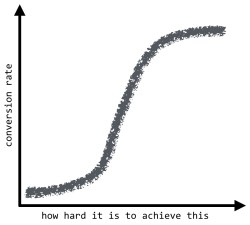
s_curve-2Moving from 96% to 97% of your maximum conversion rate will require a specialist—you’ve already done the easy optimizations—but moving from 20% to 80% is should be something you can do internally. As long as you’re heading in the right direction because you have the right strategy, it’s not so hard to make big gains in the beginning.

Statups should have an explicit strategy that drives everything in their business: it should inform their decisions in product, marketing, customer service, operations, engineering, and so on down the line. Developing that strategy is hard, but it makes other things much easier. If you need help with something, get help with that.

Tagged , ,

A Grand Unified Theory for Naming Websites

My old domain lives here.

Several weeks ago I found myself wanting to share some thoughts on a topic, and I realized it was finally time for me to get my own site; my hop onto the blogging bandwagon was seven years overdue. (Or perhaps a little early: I last had a personal website in the late 90s, and it was an eerily close approximation of today’s standard blog format. It may have looked ridiculously amateurish, however. Some Googling indicates that the name was taken over by a restaurant in Belize.)

While I have plenty of URLs lying around–many were purchased during bouts of insomnia for projects that looked significantly less brilliant the next morning—none of them seemed appropriate. It was time to pick something new. Plus, naming things is a blast.

What I was looking for

Rather than dive right in and register something, I first established my criteria.

  1. It should tell people how to feel. We all promote an image of ourselves to help shape what people think about us. While this certainly isn’t a professional site, it’s not exactly personal, either: I was searching for something timeless, something a little nerdy-cool but not hip, and something that shows I don’t take myself too seriously.
  2. It should be a good domain. That is, it should be easy to say, easy to spell, and easy to remember. No puns and no swapped/missing/duplicated letters.
  3. It should be available. I’m cheap, and my religion prohibits me from buying already-registered domains.
  4. It should be simple to illustrate. I’m not an artist, so I wanted to use preexisting images. And since I like money, I wanted to use ones in the public domain. It had to be easy to construct a site that wouldn’t embarrass me and my hypothetical future children.

The results

Hey kids! ReflexFurnace.com is still available!

It’s 2012, so pretty much any English word is long gone. I’m either inventing a new word, disemvoweling something (yuck), or choosing a compound word. I like door number 3, which meant it was time to come up with some themes, root words, prefixes, suffixes, and whatnot. After much abuse of Whois and crossing off everything Robotech-related, I came up with Sputnik 11. It immediately felt right, and five minutes later, it was mine.

  • Everyone thinks they know what Sputnik is, but this name lets me share the history of Sputnik 11.
  • The name evokes a nostalgia for a future that never was. Sputnik makes people smile. Based on the success of Mad Men, so does this entire era.
  • Those of you familiar with my background know my affection for the number 11. The ‘Eleven Learning’ name was a conversation starter, and our users loved it.

Several years ago a coworker of mine declared that anyone whose email address contained a number was just lazy. Her statement was aimed directly at me. I’ll have to ask her what she thinks of URLs with numbers in them.

I am sick of startups with terrible names

This is my plea: if you’re picking a URL—even if it’s for something as inconsequential as the site you’re reading now—have a process. Hell, you could do worse than using mine.

  1. It should tell people how to feel. Don’t recycle one you already have. Don’t choose something at random. Pick it because your audience will like it, not because you do.
  2. It should be a good domain. This reminds me of how I once talked myself out of a sure-thing consulting gig by pointing out that prospective users wouldn’t know how to spell the URL…
  3. It should be available. This is a no-brainer for a vanity blog, but it’s also true for startups. I die a little when I hear about companies that spend half their cash on a domain. And by the time a fancy domain is in their budget, their current name will have so much traction that they shouldn’t change. (The exception is when people call a site by something other than its URL, like thefacebook.com or twttr.com.)
  4. It should be simple to illustrate. OK, maybe this one just applies to me.

“We came across the word ‘twitter’, and it was just perfect. The definition was ‘a short burst of inconsequential information,’ and ‘chirps from birds’. And that’s exactly what the product was.”
Jack Dorsey

Next up

Time to pick obnoxious hipster names for those hypothetical kids.

Tagged , ,